
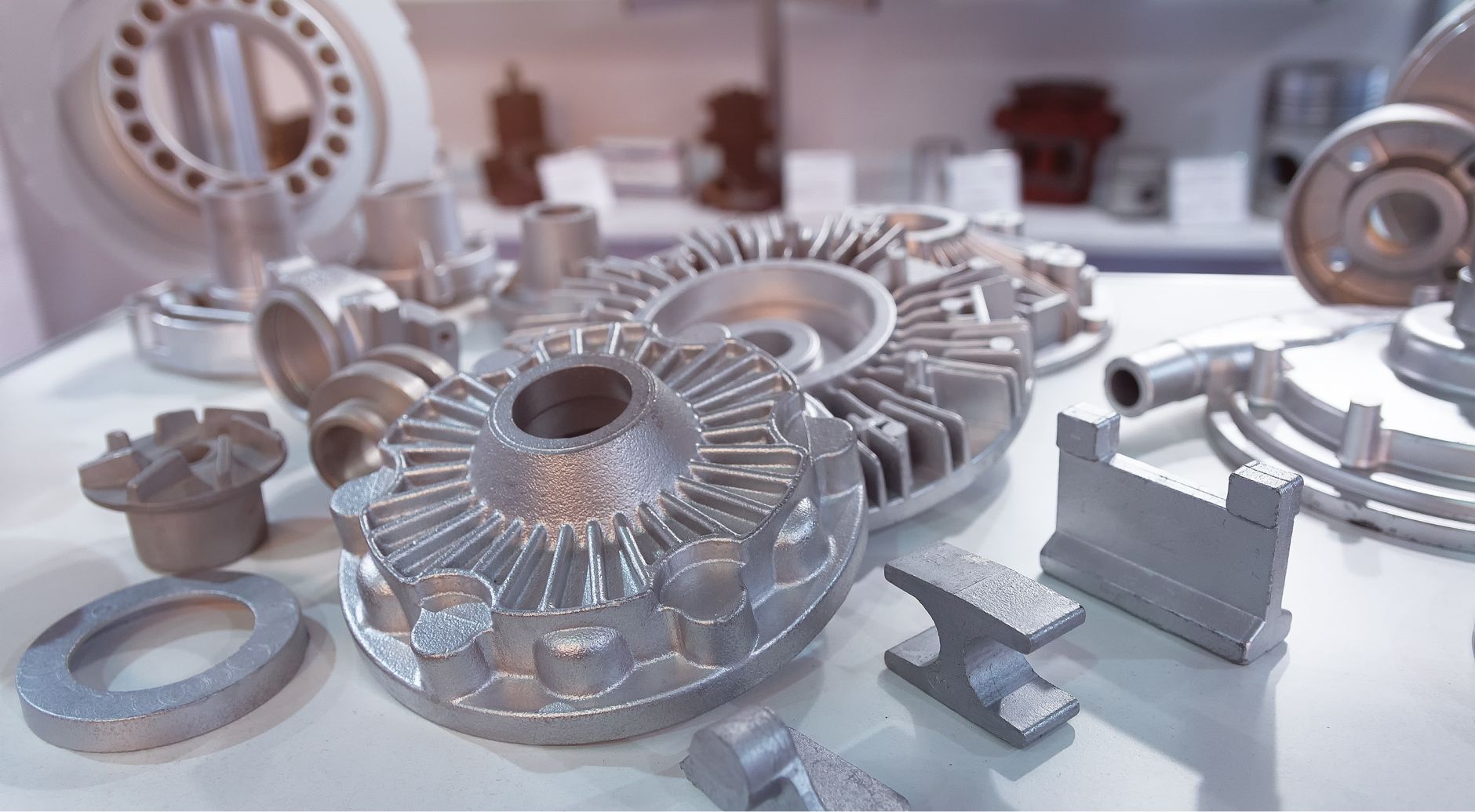
The investment casting process, also known as lost-wax casting, uses wax patterns and ceramic shells to create near-net shape parts. It’s a multi-step procedure that starts with an investment casting die and ends with components that have superior finishes and tight tolerances. High-precision investment casting allows for parts that meet exacting standards for precision, consistency, and strength.
Because of its many advantages and complex capabilities, high-precision investment casting is well-suited to a broad array of applications in fields like aerospace, aviation, industrial gas turbine, and gas compression.
In this comprehensive guide, the investment casting experts at Bescast provide a deep dive into the process of high-precision investment casting, common materials and grades, and key quality metrics.
Materials and Grades Explained
Material and grade choice directly impacts your part’s performance, durability, and cost — all factors that are especially critical in demanding, high-risk applications like aerospace, energy, or defense. The most common metals and alloys used in investment casting are stainless steel, cobalt alloys, and nickel alloys. Selecting the right material down to the grade ensures that your component meets your project’s functional requirements and continues to do so in the long term.
Materials Used in Investment Casting
The investment casting process lends itself to a wide range of materials. Common investment casting materials include:
- Stainless Steel Castings: Offering superior corrosion resistance, stainless steel castings can withstand harsh conditions and chemical exposure. Stainless steel’s high performance and wear resistance makes it ideal for casting components intended for aviation, aerospace, industrial gas turbine and gas compression applications.
- Nickel-Based Castings: Nickel-based castings are extremely versatile, offering heat resistance demanded by a wide range of applications. These castings are commonly used for components like jet engines, furnaces, exhaust systems, heat exchanges, and more.
- Cobalt-Based Alloy Castings: Cobalt offers a high level of thermal stability, and cobalt alloys are typically combined with metals like nickel, chromium, and tungsten to further enhance performance. These castings offer high-temperature resistance and hardness that make them indispensable in demanding applications where elevated temperatures are the norm.
Not sure what metal is best? Our capabilities include material selection assistance.
Investment Casting Grades
Each casting material offers unique strengths and characteristics that drive the performance of your final component. Grade choice matters significantly, too. Each grade directly determines the metal part’s strength, durability, and performance, especially when you need your component to withstand specific operating conditions and loads. Choosing the wrong grade can lead to premature part failure and unnecessary cost.
Stainless Steel
Stainless steel is the workhorse of investment casting materials. Highly popular for corrosion resistance and strength, stainless steel castings are often used in applications where corrosion is an imminent threat. Stainless castings can withstand exposure to moisture, acids, chemicals, and heat.
The most common stainless steel grades for casting include:
- Series 300
- 400 Stainless Steel Castings
- 15-5 PH Stainless Steel Castings
- 17-4PH Stainless Steel Castings
The 300 series, particularly 304 and 316, are among the most commonly used stainless steels in investment casting. With the 400 series, high nickel content means that you sacrifice some corrosion resistance, but 400 grades offer higher durability and wear resistance.
17-4PH stainless steel is highly versatile. Good resistance to stress, high strength and hardness means that 17-4PH is ideal for casting complex shapes and strong components. Among its many applications, this material is often used for landing gear parts, oil and gas valves, and turbine blades.
15-5 stainless steel is a premium grade that offers superior transverse toughness and ductility, along with high strength and superior corrosion resistance. This is stainless steel for the most demanding applications, commonly used in driveshafts, gears, nuclear reactor components, and more.
Cobalt-Based Alloys
Ideal for high-stakes applications where temperature resistance, hardness, and wear and corrosion resistance are all non-negotiables, cobalt alloys are among the most robust investment casting materials.
Common cobalt alloys include:
- MM509
- L605
- X40 (S31)
- WI-52
Cobalt-based alloys are not easy to work with, and cobalt investment castings demand a high level of skill and expertise. The cost is typically higher with most cobalt grades, as well. However, the result is a high-performance part that offers an exceptional level of thermal stability and wear resistance.
Nickel-Based Alloys
When you demand extreme levels of high-temperature resistance from your parts, nickel-based alloys step up to the plate. Nickel-based castings perform consistently and reliably in demanding conditions where high heat or chemical exposure would threaten other materials.
Among the most sought-after nickel-based grades, Hastelloy (HastX) offers premium high-temperature strength and critical resistance to oxidation, with a range of forming capabilities.
Common nickel-based alloys include:
- HastX
- IN625
- IN713
- IN718
- IN738
- IN792
- MM247
- R77
- R80
- R125
- U500
Like cobalt-based alloys, nickel-base alloys are more expensive and more complex to work with than conventional steel, but they offer unparalleled performance under the most aggressive conditions.
Key Benefits of Investment Casting
Precision casting is ideal for lightweight, complex components for applications where precision is critical for performance. It’s a highly versatile process that allows for a significant degree of design freedom, allowing manufacturers to create intricate, detailed components that may be difficult or impossible to produce through other casting methods.
Other benefits include:
- Efficiency: Its exceptional accuracy and repeatability often eliminate the need for secondary machining, reducing overall production costs.
- Reduced waste: Because the process yields such accurate castings, it significantly reduces material waste.
Style & Finish: Investment casting is known for its excellent surface finish, often providing a smooth, polished result without the need for additional finishing or polishing.
High-Precision Investment Casting Step by Step
Investment casting dates back to more than 5,000 years ago when it was used to create intricate metal jewelry and art. Today, investment casting is often used to manufacture highly precise custom metal parts that serve a diverse range of industries, including military and aerospace applications.
But the process hasn’t changed much — it’s still one of the most effective ways to cast detailed components. Let’s dive right into the precision investment casting process, step by step:
1. Creating a Wax Pattern
It all begins with a wax model, or pattern. Each pattern is created in a custom shape that mimics the desired metal part. These wax patterns are made by injecting wax into a metal die that forms a perfect replica of the end product.
The wax patterns are attached to wax tree, or sprue. This tree is a gated system that will allow the molten metal to flow freely into every portion of the cast component. If the final product is small, a tree can accommodate numerous wax patterns. For oversized parts, there may be just one pattern per tree.
2. Creating Ceramic Shells & Removing the Wax
The wax trees are dipped into a ceramic slurry, and granular refractory stucco or sand is applied to the wet surface. Each layer is allowed to harden before a new layer is created, and the entire process is repeated to create the layered ceramic mold.
The size and shape of the end product, along with the temperature of the molten metal, determine the thickness of the ceramic shells. In the end, the dried ceramic shells will be sufficiently hard to contain the molten metal.
The ceramic shells are treated in a flash-fire oven to melt and remove the wax. The hollowed-out shells contain a cavity that matches the shape of the desired component.
3. Pouring the Metal
The ceramic shells are heated to an appropriate temperature, usually around 1,000°F to 2,000°F. At this temperature, the shells are further strengthened, residual wax melts away and any moisture in the shells dissipates. Once the shells reach the target temperature, they’re filled with molten metal. The temperature of the metal is usually significantly higher than the mold, ensuring it flows into all areas before solidifying.
4. Cooling & Finishing
Once filled, the ceramic shells are set to cool, allowing the metal to solidify. The cooling rate can be controlled by the thickness of the ceramic shell and the ambient temperature around it. This solidification process can take a few minutes to a few hours.
When the metal has solidified, the ceramic shells are removed through a knockout operation. The sprues and gates that allowed the metal to flow into the shells are also removed.
Finally, the metal castings go through a finishing process. This can include sandblasting to remove any remaining ceramic material, heat treatment to alter the properties of the metal, or minor machining to achieve the final dimensions.
Understanding Investment Casting Accuracy Grades
Complex geometries and high degrees of part accuracy are the two biggest advantages of the investment casting process. High-precision investment casting can achieve tight tolerances that other processes simply cannot.
Understanding accuracy grades can help you minimize inaccuracies and achieve high levels of consistency from part to part.
Why Tolerances Matter
Investment casting accuracy grades indicate how accurate a mold is, and how consistent the resulting castings will be. These grades correspond to dimensional and geometrical tolerances.
Investment casting tolerances are defined by three bands: coarse, intermediate, and small (CT, IT, and ST). Each band has its own tolerance levels, which progress from tightest to loosest. The CT band is the band most commonly used by foundries.
Most investment casting foundries aim to maintain an accuracy grade between CT4 and CT8. At CT4 the tolerance on a dimension of 40 to 63 mm is 0.36 mm. At CT8 the tolerance on the same dimension is 1.4 mm. These are tight tolerances that can’t be achieved by other common processes like sand casting.
Factors That Affect Investment Casting Tolerance
Tolerances can vary from foundry to foundry, depending on thin-wall capabilities and large part production. Key factors that directly impact investment casting tolerance include:
- Ceramic material used
- Mold temperature
- Rate of cooling
- Position on the tree
- Injection pressure
- Firing and heat treat temperatures
Investment Casting Quality Control
Quality control measures like dimensional inspections, material testing, and structural analysis are critical throughout the casting process to ensure that your final parts meet the highest quality standards.
At Bescast, we hold a number of industry certifications that speak to our product quality and consistency, including:
- ISO 9001:2015
- AS9100 Rev D
- Nadcap
- Heat Treat
- NDT (Non-Destructive Testing) (Radiography & Penetrant)
- Welding
Casting Your Next Success Story With Bescast
Since 1945, Bescast has been a trusted name in state-of-the-art high-precision investment casting, specializing in cast air foil configurations. With our vertical integration of the complete investment casting process, including the core manufacturing process, solidification modeling, rapid prototyping, and CNC milling and machining, Bescast provides a bespoke service that rises to meet any challenge.
Partner With a Leading High-Precision Investment Casting Manufacturer
At Bescast Precision Investment Castings, we specialize in high-precision investment casting specifically tailored to the unique performance demands of the aerospace, defense, and petroleum industries. We offer a seamless production path, all of which takes place right here at our 80,000-square-foot facility. You’ll work closely with our engineers throughout every stage of the process, from prototyping to production. For projects that demand complexity and precision, trust Bescast to deliver.
Contact us today for a quote or to schedule a tour at our facility in Willoughby, Ohio.
Frequently Asked Questions
What size of investment casting products are possible?
Investment casting products can be as small as a few ounces or as large as 800 pounds or more.
Why is it called investment casting?
“Investment” refers to the ceramic slurry that “invests” or covers the wax pattern, creating the ceramic mold.
What types of investment casting does Bescast provide?
We specialize in air, vacuum, and dual-chamber vacuum investment casting.
Can the wax models used in casting be recycled?
Yes. The investment casting wax can be reclaimed and reused.